
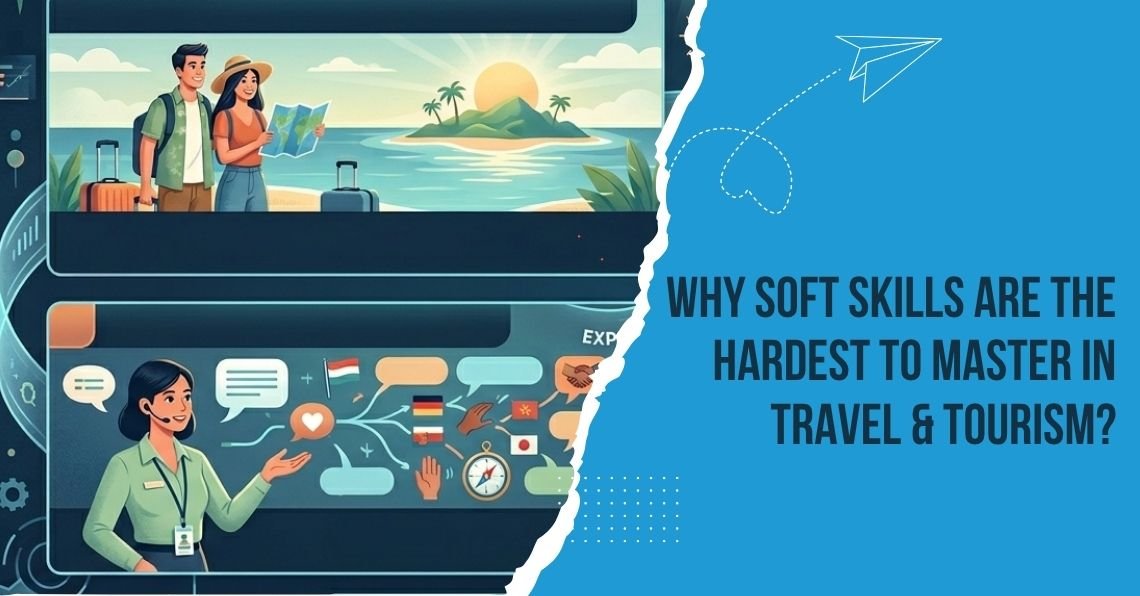
In the fast-paced and people-centric world of Travel and Tourism, technical knowledge can take you places. but soft skills determine how far you go. Whether you’re a tour guide, travel consultant, airline staff, or hotel professional, your ability to communicate, empathize, and adapt can make or break a traveller’s experience.
Yet, while these skills are often called “soft,” mastering them is anything but easy. Let’s explore why.
1. The Travel Industry Is All About People
At its heart, the travel and tourism industry is built on human interaction. Every day, professionals engage with people from diverse cultures, languages, and emotional backgrounds.
From calming a frustrated travellers to creating unforgettable experiences, it takes more than a smile, it takes emotional intelligence, patience, and empathy.
Unlike technical skills, there’s no single formula or manual for understanding human behavior. Every interaction is different, making soft skills a lifelong learning process.
2. You Can’t Learn Soft Skills from a Textbook
Booking systems, destination knowledge, and airline codes can be taught in classrooms. But qualities like confidence, adaptability, communication, and teamwork can only be developed through experience and self-awareness.
It’s not about memorizing, it’s about practicing.
Students at Ties Institute, for example, engage in real-life roleplays, presentations, and internships that build interpersonal skills from the ground up.
3. Emotional Balance Is the Hidden Challenge
Travel professionals often work in high-pressure environments, dealing with last-minute changes, delays, and diverse customer expectations.
The hardest skill here isn’t just communication; it’s keeping calm under pressure and maintaining positivity.
Managing emotions while delivering service with a smile is what separates a good travel professional from a great one.
4. Cultural Sensitivity Takes Time and Experience
With globalization, traveller’s come from all corners of the world. Understanding and respecting different cultures, values, and communication styles takes genuine curiosity and practice.
A simple gesture or phrase that’s polite in one culture might be inappropriate in another. Developing this awareness isn’t instant, it evolves through experience and exposure
3. Emotional Balance Is the Hidden Challenge
Many students might be curious about how to earn high salaries after finishing 12th. There are many options. Students can choose from various high-salary courses Travel & Tourism after completing the 12th. It all depends on your skills and interests. Hard work will make it easier to choose a high-paying career. Below are some tips for earning a high-paying job after your 12th grade.
5. Technology Can’t Replace Human Connection
In the era of chatbots, AI, and automated booking systems, it’s tempting to think machines can do it all. But when traveller’s face confusion, fear, or excitement, only a human touch can truly connect.
That’s where soft skills like empathy, listening, and problem-solving shine. These are the traits that build trust, something no technology can fully replicate.

6. Continuous Growth Is Key
Soft skills aren’t mastered once; they’re constantly refined. As travel trends, guest expectations, and cultural norms change, professionals must evolve too.
Workshops, peer feedback, and self-reflection help individuals strengthen these abilities over time.
Conclusion
In travel and tourism, soft skills are your strongest passport.
They are the bridge between destinations and experiences, between information and emotion.
While mastering them takes time, patience, and practice, the rewards are immeasurable, satisfied traveller’s, meaningful connections, and a career that truly makes a difference.
At Ties Institute, we believe that great travel professionals are made not just by knowledge, but by heart.